
To pay off debt, list everything you owe, keep paying every minimum, and put every extra dollar on one debt at a time until it is gone. Then roll that payment into the next debt. Which one goes first is the only real choice: the smallest balance (the debt snowball) or the highest interest rate (the debt avalanche).
The order matters less than the extra money. Pick one and start this week.
Debt Payoff Calculator: Snowball vs. Avalanche
Enter each debt’s balance, interest rate and minimum payment, then add what you can pay on top. You will see the debt snowball and the debt avalanche side by side. It is free, and nothing you type leaves this page.
Paying $720 a month in total: $520 in minimums plus $200 extra.
The avalanche saves $720 in interest and finishes 1 month sooner. The snowball clears your first debt in month 4, the avalanche in month 19.
If the payoff date looks doable, follow the plan below. If it runs past five years, or the payment does not cover the interest, lower your rate first. If you can no longer keep up with your payments, compare debt relief companies.
Follow the plan, starting with step 1See four ways to lower your interest rateDebt settlement is for people with $7,500 or more in credit card, medical or personal loan debt who can no longer keep up with the payments. Your credit takes a hit while it happens, and no result is guaranteed.
Compare the best debt relief companiesOur top pick there is National Debt Relief. Free consultation. Its fee, up to 25% of the debt you enroll, is charged only after a debt is settled.
See if you qualifyWith less than $7,500 in total, debt settlement is not the tool. Two better moves:
Find extra money on a low incomeCall your creditors and ask for a payment you can affordHow the math works: interest is added once a month at your rate divided by 12. You pay every minimum, and the extra goes to one debt at a time. When a debt is paid off, its payment rolls to the next one. The calculator assumes your minimums stay the same and you add no new charges, so treat the result as an estimate. Your lender’s own math can differ by a few dollars.
Not everyone is starting from the same place. Tap the line that sounds like you.
I was featured on AOL after paying off $30k of student loan debt within 12 months after graduating college. Proof below:
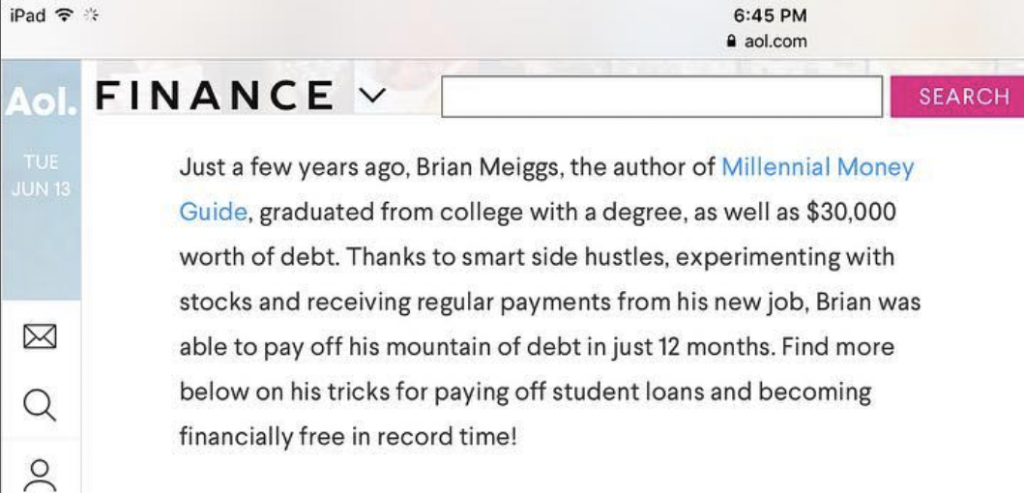
I created this free guide so you can follow the same path. And you would not be alone on it. Americans owed $18.8 trillion in household debt in the second quarter of 2026, including $1.26 trillion on credit cards, according to the Federal Reserve Bank of New York. An Experian study put the average balance at $105,444 per person in September 2025, or $21,603 without mortgages. We keep more personal finance statistics here.
Step 1: List Every Debt You Owe
This is the first thing to do today, and it takes about 20 minutes. Pull up every statement or log in to every account. For each debt, write down four things: who you owe, the balance, the interest rate (APR) and the minimum payment. Include the ones you would rather not look at, like the medical bill or the store card.
Not sure you have found them all? Check your credit reports. The three credit bureaus let you pull yours free once a week at AnnualCreditReport.com, which the FTC says is the only website authorized to fill those orders.
Here is the example that is filled in the calculator above. I will use it for the rest of this page.
| Debt | Balance | Rate (APR) | Minimum payment |
|---|---|---|---|
| Medical bill | $900 | 0% | $40 |
| Personal loan | $3,000 | 11.9% | $110 |
| Credit card A | $5,200 | 24.99% | $135 |
| Credit card B | $9,400 | 22.36% | $235 |
| Total | $18,500 | Varies | $520 a month |
That is $18,500 of debt and $520 a month in minimums. The rates are not random. In August 2026 the Federal Reserve put the average rate on credit card accounts that were charged interest at 22.36%, and the average two-year personal loan from a bank at 11.90% (Federal Reserve G.19).
A spreadsheet or a sheet of paper works fine. If you would rather not type it all in, Empower has a free dashboard that connects your accounts in one place, with a debt paydown view that shows everything you owe. We compare more options in our guide to budgeting tools.

- Track your portfolio and see your full financial picture in one place
- Optimize your investments with advanced retirement projections
- Get started for free and take control of your retirement today
Not sure how serious your number is? These four tests show how much debt is too much.
Step 2: Set Aside a Small Cushion First
Before you throw every spare dollar at debt, save a small cushion. Without one, the next flat tire goes right back on a card and you lose the ground you just gained.
It does not have to be big. Even a few hundred dollars changes what happens when something breaks. Our guide to building an emergency fund covers how much you need and where to keep it. If saving anything feels impossible right now, start with why you can’t save money and fix that leak first.
Keep the cushion in a savings account that is separate from your everyday checking, so it does not get spent by accident. SoFi Checking and Savings is one option. SoFi says its savings rate is 9 times the national average savings rate, and you can manage the account from the SoFi app.

- Earn $50 or $400 with eligible direct deposit
- No account fees, no overdraft fees, ever
- 0.90% APY boost on savings for up to 6 months
Should you pay off debt or save first? Do both, in this order: a small cushion, then your high-interest debt, then a full emergency fund. Keep paying every minimum the whole time.
Step 3: Pay Every Minimum, Then Put Every Extra Dollar on One Debt
Pay every minimum on time, every month. Payment history is the biggest piece of a FICO score, 35% of it, by FICO’s own breakdown. A missed payment costs more than it saves.
Then find one amount you can add every month and aim all of it at a single debt. The extra matters more than anything else on this page. Here is a $5,000 card balance at 22.36%:
| Monthly payment | Time to pay it off | Interest you pay |
|---|---|---|
| $125 | 75 months (6 years 3 months) | $4,261 |
| $225 | 29 months | $1,515 |
| $325 | 19 months | $947 |
An extra $100 a month cuts almost four years off and saves about $2,746 in interest. That is why minimum payments feel like a treadmill: at $125 a month, about $93 of the first payment is interest.
These numbers assume a fixed payment and no new charges on the card. The lesson holds for every debt you have: the higher the rate, the less of each payment touches the balance. Here is more on what interest rates do to your money.
Step 4: Pick Your Order: Debt Snowball vs. Debt Avalanche
Both methods work the same way. You pay the minimum on everything and send all the extra money to one debt. When it is gone, its whole payment rolls into the next one. The only difference is which debt goes first.
Debt snowball: smallest balance first, no matter the rate. You get a paid-off debt quickly, and that win keeps you going.
Debt avalanche: highest interest rate first. It takes longer to see a debt disappear, but you pay less interest overall.
Here is the same example worked both ways, with $720 a month going out: the $520 in minimums plus $200 extra.
| What happens | Debt snowball | Debt avalanche |
|---|---|---|
| Payoff order | Medical bill, personal loan, card A, card B | Card A, card B, personal loan, medical bill |
| First debt gone | Month 4 | Month 19 |
| Debts gone in year one | 2 | 0 |
| Debt-free in | 36 months | 35 months |
| Total interest | $6,801 | $6,081 |
| Total paid | $25,301 | $24,581 |
Same debts, same $720 a month. The avalanche saves about $720 and finishes a month sooner. The snowball knocks out two debts in the first year, while the avalanche does not clear one until month 19.
And the extra $200 does the heavy lifting either way. With no extra money, the same $520 a month takes 58 months and costs about $11,400 in interest.
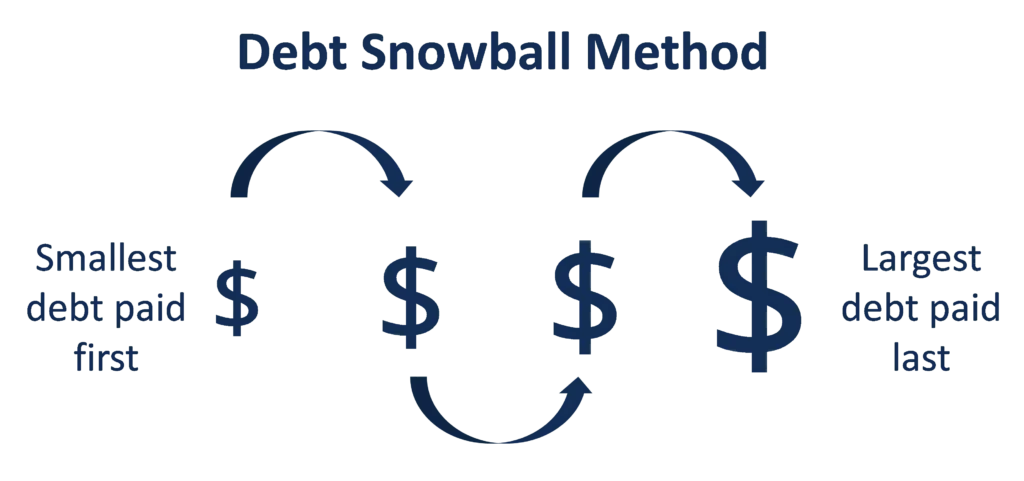
The debt snowball is what I used to pay down my own debt, and it is still my favorite method. Watching debts disappear one by one builds momentum.
Which should you pick? If the math motivates you, go avalanche. If you have started and quit before, go snowball, because the plan you stick with beats the plan that is cheaper on paper. If your smallest debt also has your highest rate, they are the same plan.
More7 tips to become debt free as quickly as possible
Want to see your own debts both ways? Go back up to the debt payoff calculator and swap in your numbers.
Apps That Keep You on the Plan
The calculator gives you the plan. An app can keep you on it. Our roundup of debt payoff apps covers the free options.
If your debt is spread across a few cards plus a loan or two, the hard part is seeing all of it in one place. Monarch Money pulls every account into one dashboard so you can watch the balances come down.
Be straight with yourself on this one though. Monarch is a paid app, at $14.99 a month or $99.99 a year after a free first week, so it earns its keep when you have several accounts to watch rather than a single checking account. You can start with the free trial.
Qube Money takes the cash envelope method and puts it in an app. You set money aside in a digital envelope before you spend it. It is a paid app as well: $14 a month after a 15-day free trial, with no free plan. If envelopes are how you think about money, you can try Qube Money.

Qube Money offers paid plans with a free trial and a host of useful features, which makes downloading this app a no-brainer. Budgeting doesn’t have to be complicated or unpleasant with this new budgeting app.
How to Pay Off Debt on a Low Income
On a low income the plan above does not change. What changes is how hard the extra money is to find. It can only come from three places: help you qualify for, bills you can shrink and income you can add. If you are tired of being broke, start here.
MoreHow to pay off debt when you live paycheck to paycheck
Check for Help You Qualify For
Before you cut anything, see what you are eligible for. The federal government’s benefits page at USA.gov points you to help with food, health insurance, housing and utility bills. Every dollar of help with groceries or the power bill is a dollar that can go to debt.
A nonprofit credit counselor can also go through your budget with you for free or at low cost. More on that below.
Shrink the Bills You Already Pay
The price your cable, phone or internet company quotes you is not always the best one it can offer. Call, ask for the retention department and say you have been offered a better deal somewhere else. Seriously, I have lowered my AT&T bill by doing this.
If they will not budge, switch. A lot of people overpay for home internet when a cheaper WiFi plan would do the job.
Do not want to make the calls yourself? Bill negotiation services do it for you. The best known is Rocket Money, and our Rocket Money review has the details. It negotiates with your providers on your behalf and charges 35% to 60% of the first year’s savings, only when it gets you a lower bill.
I sent Rocket Money my utility bills and saved $200 in 4 days. It found ways to lower my cable bill and cell phone bill and canceled useless subscriptions I was paying for. That is $200 that can go toward getting rid of debt. You can try Rocket Money with a free account. Its Premium plan runs $7 to $14 a month.
- Lower your internet, phone, and cable bills automatically
- Trusted by 10 million+ members to cut monthly expenses
- Contacts providers to find discounts and hidden savings
- Saves users an average of $300 per year
Housing is usually the biggest bill of all. If you can take on a roommate, move in with family for a year or find another way to live rent free, you free up more than any phone plan ever will. Looking for more ideas? Forbes Advisor’s personal finance section is another place to look.
Sell What You Don’t Use
Do you have an old phone lying around? I usually upgrade my phone once every two years and sell my old one online. Do not wait too long, because electronics lose value every year they sit in a drawer.
Local selling apps are the easiest way to turn clutter into cash. For specific items, here is where to sell used DVDs, sell clothes online, find consignment shops near you, sell used furniture and sell a laptop.
Selling is a one-time boost, not a plan. Put the whole amount on the debt you are attacking.
Add Income
When there is nothing left to cut, the only move left is earning more. It does not have to be a second full-time job. Part-time weekend jobs, gig economy jobs and side hustles can all fit around the job you have, and our list of ways to make extra money has something for almost everyone. Here are three we have reviewed.
DoorDash driver. The hours are flexible, and DoorDash says 100% of customer tips go to the Dasher. Pay goes out weekly, or once a day through Fast Pay for $1.99 per cash out.

- Work whenever you want, no set shifts
- Cash out earnings daily with Fast Pay
- Unlike rideshare, no dealing with riders
- Keep 100% of customer tips
Swagbucks. You earn points for surveys, shopping online and other small tasks, then cash out to PayPal or free gift cards. This is pocket money, not a paycheck.

- Earn points by taking surveys, playing games, and shopping online
- Redeem rewards like PayPal cash or gift cards to top brands
- Join millions who’ve earned over $706 million with Swagbucks
- $10 welcome bonus when you activate it and spend $25 in the Swagbucks shop within 30 days
Survey Junkie. One of the paid survey sites we cover. You answer surveys for points, then redeem them for PayPal cash or e-gift cards. The same warning applies: it is small money.

- Share your opinion to help brands deliver better products and services
- Fast payouts, legit, and our favorite survey site
- Has paid out more than $25 million to its members
Love animals? Pet sitting or dog walking through Rover pays you for something you might do for free. Need a set amount quickly? Here are ways to make $500 fast.
One rule covers all of it: the extra money is for the debt. Treat the side work like a weekend job with one purpose, and set up an automatic payment for the day after the money lands, before it can turn into spending.
Fix Your Tax Withholding
If you get a big tax refund every spring, more tax than necessary is coming out of every paycheck. A new W-4 puts that money in your check each payday, where it can go to debt instead of sitting with the IRS until you file.
The old question of whether to claim 1 or 0 on your W-4 does not apply to today’s form, so read that guide before you change anything. Do not overdo it. Withhold too little and you will owe at tax time.
Lower Your Interest Rate
Every point you take off the rate is money that goes to the balance instead of the lender. There are four ways to do it, and each one can backfire.
| Option | What it does | Fits when | Backfires when |
|---|---|---|---|
| Ask your card company | You ask for a lower rate or a payment plan you can afford | You are current, or just starting to slip | You do not get the new terms in writing |
| Balance transfer card | Moves card debt to a new card with a 0% or low promotional rate | You can get approved and can clear the balance before the promotion ends | The promotion ends and the rate rises, or you keep spending on the cards |
| Debt consolidation loan | One fixed loan pays off your cards and leaves you one payment | The new rate is lower than your cards charge | A longer term costs you more in total, or the loan is secured by your home |
| Debt management plan | A credit counselor works out lower rates and one monthly payment. You repay in full | You could keep up if the rates were lower | You cannot make every payment for the whole plan, which can take 48 months or more |
Ask Your Card Company First
This one is free and takes a phone call. The FTC’s advice is to call the number on your card or statement, ask to negotiate a lower interest rate and suggest a payment plan you can afford. You do not need to pay anyone to make that call for you. Keep a record of who you talked to and what they agreed to, and ask for the agreement in writing.
Balance Transfer Cards
A balance transfer moves what you owe to a card with a 0% or low promotional rate, so more of each payment goes to the balance. The CFPB flags the catches: the promotional rate lasts for a limited time, you will probably pay a balance transfer fee (a percentage of what you move or a fixed amount, whichever is more), and if you are more than 60 days late the card company can raise your rate on the whole balance.
Do the math before you move anything. Divide the balance by the number of promotional months. If you cannot pay that much each month, the transfer only delays the problem.
Debt Consolidation Loans
A consolidation loan pays off your cards with one fixed loan. It only helps if the new rate is lower than what your cards charge. In August 2026 the average two-year personal loan from a bank ran 11.90%, against 22.36% on card accounts that were charged interest, according to the Federal Reserve. Your own offer depends on your credit.
Watch the term. The CFPB warns that a lower monthly payment may only mean you are paying over a longer time, which can cost you a lot more overall. And be careful with any loan secured by your house. The FTC warns that if you cannot make the payments, you could lose your home.
Start with whether debt consolidation is a good idea for you. If it is, compare lenders in our guide to the best personal loans. SoFi personal loans are one option to price out, and Navy Federal members can read our Navy Federal debt consolidation review.
Credit Counseling and Debt Management Plans
A nonprofit credit counselor reviews your whole budget, usually for free or at low cost. If it fits, the counselor can set up a debt management plan. The CFPB describes it this way: you make a single payment to the counseling organization each month, and it pays each of your creditors. A plan typically lowers your monthly payments along with your interest charges and fees.
You repay everything you owe, so nothing is forgiven and nothing is taxed. The trade-offs, according to the FTC: a plan can take 48 months or more, and you might have to agree not to apply for or use any more credit until it is finished. Ask for every fee in writing before you sign.
To find a counselor, the FTC suggests credit unions, universities and military personal financial managers. You can also check the U.S. Trustee Program’s list of approved credit counseling agencies. Walk away from any counselor who pushes a plan before reviewing your finances.
If You’re Behind or Can’t Pay
If you cannot cover your minimums, the order changes. Cover housing, utilities, food and the car you need for work first. Then work through the steps below, starting with a phone call.
Call Your Creditors Before a Collector Does
Do not wait. The FTC says to call the companies you owe before a debt collector gets involved, tell them what is going on and try to work out a new payment plan with lower payments. A creditor might be willing to negotiate, and might even agree to accept less than you owe.
The clock matters. If you miss your minimum payments for four to six months, the FTC says your creditor may charge off the debt as a loss. You still owe it, your credit can take another hit and the debt can be sold to a collector.
Debt Collectors: What They Can and Cannot Do
Once a debt goes to a collector, a federal law called the Fair Debt Collection Practices Act limits what that collector can do. These are the basics, from the FTC’s debt collection FAQs and the CFPB’s debt collection rule.
| The rule | What it means for you |
|---|---|
| Calling hours | No contact before 8 a.m. or after 9 p.m., unless you agree to it |
| Call limits | No more than seven calls within seven days about a particular debt, and no call within seven days after a phone conversation about it. People call this the 7-in-7 rule |
| At work | A collector cannot contact you at work if you say you are not allowed to get calls there |
| Proof of the debt | When it first contacts you, or within five days, the collector has to send validation information: its name, who you owe and how much, including interest and fees |
| The original creditor | You can ask who the original creditor was if you do it within 30 days of getting that information |
| Stopping contact | Mail a letter asking the collector to stop contacting you. After that it can only confirm it will stop, or tell you about a specific action like a lawsuit |
| Old debts | Once the statute of limitations runs out, a collector cannot sue you or threaten to. The time limit depends on your state and the kind of debt |
That last rule is easy to get wrong. The time limit is set by state law, and the CFPB warns that a partial payment on an old debt may restart the clock. Before you pay anything on a very old debt, find out your state’s limit or ask a lawyer.
How to pay off a debt in collections. Talk to the collector at least once so you can confirm the debt is yours and the amount is right. Do not share personal or financial information until you know the collector is real. Check how old the debt is. If you owe it, offer what you can afford and get the agreement in writing before you send any money.
More help: a better way to handle debt collection calls and how to stop collection agency harassment.
If You’re Sued
Respond by the date in the court papers, either yourself or through a lawyer. The CFPB explains why: if you do not respond, the court can enter a default judgment, and a judgment can let the creditor garnish your wages, place a lien on your property or freeze money in your bank account, depending on your state. Responding makes the collector prove the debt is valid.
Debt Settlement
Debt settlement means paying a creditor a lump sum that is less than what you owe. A debt relief company can negotiate it for you, or you can try it yourself. The FTC lists the risks plainly: these programs often encourage you to stop paying your creditors, your credit report and score are likely to be damaged, late fees and interest keep growing, you could be sued while you wait, and many people drop out before their debts are settled.
Two rules to know. A debt settlement company cannot collect its fee before it settles a debt. And any amount that is forgiven could count as taxable income, which is covered under taxes on forgiven debt.
Settlement fits a narrow group: people with a lot of card debt who truly cannot keep up, and who can put money into a savings account every month for a few years. If that is you, read our review of the best debt relief companies before you call anyone. It covers what settlement costs, what it does to your credit and who should skip it.

National Debt Relief is for people with $7,500 or more in credit card, medical or personal loan debt who can no longer keep up with the payments.
See if you qualifyFree consultation. Its fee, up to 25% of the debt you enroll, is charged only after a debt is settled
These are National Debt Relief’s own published figures. The savings number is for clients who finish the program. Not everyone does, and no result is guaranteed. One of its pages puts the minimum at $10,000.
Owe less, or still able to make your payments? Read this firstBankruptcy
Bankruptcy is a legal tool, and for some people it is the right one. A discharge is a court order that says you do not have to repay certain debts. It can get rid of credit card and medical debt and stop garnishments, repossessions and debt collection activity.
There are two main kinds for individuals. Chapter 7 sells off assets that are not exempt and clears eligible debts. Chapter 13 lets people with a steady income keep their property and repay some of what they owe over three to five years. Court fees come to $335 for Chapter 7 and $310 for Chapter 13, before any attorney costs.
The costs are real. A bankruptcy stays on your credit report for 10 years, and it usually will not erase child support, alimony, fines, taxes or most student loans. If you could not pay back even half of what you owe in the next few years, talk to a bankruptcy attorney before you sign up for anything else.
MoreBankruptcy mistakes to avoid before you file
What to Do by Type of Debt
The plan is the same for every debt, but each kind has its own rules and its own ways out.
Credit Card Debt
Cards are usually the most expensive debt you carry, so they usually go first in an avalanche. Stop adding to the balance, call and ask for a lower rate, and send your extra money here. Working on a specific number? Here is our plan to pay off $5,000 in credit card debt.
MoreHow to pay off credit card debt when you have no money
Medical Debt
Do not pay a medical bill until you have checked it. The CFPB’s advice is to make sure the provider calculated the bill correctly and that you owe it, then ask about financial assistance, sometimes called charity care. If you still owe, negotiate the amount down or ask for an interest-free repayment plan.
Be careful about moving a medical bill onto a credit card. The CFPB warns that you may pay high interest and lose the ability to negotiate the debt. A bill on an interest-free plan costs nothing to carry, which is why the medical bill goes last in the avalanche example above.
Student Loans
Federal and private loans play by different rules. With federal loans, call your loan servicer before you miss a payment. Federal Student Aid lists the repayment plans, including fixed plans and income-driven plans such as Income-Based Repayment (IBR) and the newer Repayment Assistance Plan (RAP), which set your payment by your income and family size. Applying is free, and the FTC says you do not have to pay anyone for help with your student loans.
Do not let a federal loan sit unpaid. A payment that is 90 days late is reported to the credit bureaus, and the loan is in default after 270 days. Default can mean garnished wages and withheld tax refunds. The two main ways out are loan rehabilitation, which takes nine agreed monthly payments, and loan consolidation.
Private loans have fewer options, so the fix is usually a lower rate. We compare lenders in our guide to the best student loan refinance companies, and SoFi student loan refinancing is one lender that does it. One warning: refinancing a federal loan with a private lender turns it into a private loan, with the fewer options that come with one. Our guide to paying off student loans covers plans, forgiveness and payoff strategies.
Car Loans
If you are struggling with a car payment, contact the lender as soon as possible. The FTC says many lenders will work with you if they think you will be able to pay soon. Do not wait, because most contracts let the lender repossess the car as soon as you default, without notice.
Giving the car back voluntarily does not end it either. You still owe the difference between your balance and what the lender gets for selling the car. If you know you cannot keep up, you might be better off selling the car yourself and paying off the loan.
Payday Loans
Pay these off before anything else. The CFPB says a charge of $15 for every $100 borrowed is common, which works out to an annual rate of almost 400% on a two-week loan. Rolling one over is how people get stuck. On a $300 loan, you pay $45 to extend it and still owe the full $300 plus another $45.
Ask the lender about an extended repayment plan. Some states require lenders to offer one, sometimes at no extra cost. Here are more ways to pay off payday loans faster.
Tax Debt
You can set up a payment plan with the IRS yourself. If you can pay in full within 180 days, a short-term plan gives you the time. If you need longer, a long-term installment agreement lets you pay monthly, and you can apply online if you owe $50,000 or less in combined tax, penalties and interest. Penalties and interest keep adding up until the balance is paid in full, so pay it down as fast as you can.
If you truly cannot pay the full amount, an offer in compromise lets you settle your tax debt for less than you owe, and the IRS has a pre-qualifier tool to check whether you are eligible. Be wary of any company that promises to wipe out tax debt for pennies on the dollar before it has looked at your situation. The FTC warns about exactly that pitch.
What Paying Off Debt Does to Your Credit
Mostly good things. A FICO score is built from five categories: payment history (35%), amounts owed (30%), length of credit history (15%), new credit (10%) and credit mix (10%). Paying on time and shrinking your balances works on the two biggest ones.
The routes that hurt are the ones where you stop paying. Negative information about your payment history can stay on your credit report for up to seven years, and a bankruptcy for up to 10, according to the CFPB.
How to get out of debt without ruining your credit: keep every account current while you pay it down, and use a route where you repay in full, like the snowball, the avalanche, a lower-rate loan or a debt management plan. Settlement and bankruptcy are for when that is no longer possible.
Once the balances are falling, here is how to improve your credit score. You can watch it for free in plenty of places, and SoFi’s free credit score monitoring is one of them.
Taxes on Forgiven Debt
If a creditor cancels or forgives part of what you owe, the IRS generally treats the canceled amount as income for the year it was canceled (IRS Topic 431). A creditor that cancels $600 or more reports it on Form 1099-C and may send you a copy. You are responsible for reporting the right amount even if the form you get is wrong.
There are exclusions. Debt canceled in a bankruptcy case is not income. Neither is canceled debt up to the amount you were insolvent, meaning your debts were more than everything you owned right before the cancellation. IRS Publication 4681, written for 2025 returns, gives an example: with $10,000 in debts and $7,000 in assets you are insolvent by $3,000, so you can exclude $3,000 of a $5,000 canceled debt. You report an exclusion on Form 982.
Student loans have their own rules. A temporary federal break covered certain student loan discharges from 2021 through the end of 2025. Cancellation because of death or total and permanent disability is still on the IRS list of amounts that are not income. If a loan is forgiven in 2026 or later, check with a tax professional before you file.
Paying a debt in full, whether through the snowball, the avalanche or a debt management plan, does not create canceled debt, so there is nothing to tax. These are the federal rules for tax years 2025 and 2026. Your state may treat canceled debt differently.
How to Stay Out of Debt
The month your last payment clears, the money you were sending to debt has no job. In the example that is $720 a month. Give it one before it disappears.
First, finish your emergency fund so the next surprise does not start a new balance. Then send the old debt payment to your future: your retirement accounts first, then an investing account such as SoFi Invest if you want one.
It also helps to know what got you here. Read how people get into debt in the first place, whether it was an emergency, a big one-time cost like a wedding or spending that crept up. Then build the habits that keep it from happening again: live below your means, learn the basics of money management and unsubscribe from the sale emails your favorite brands send.
For what comes next, read what to do when you are finally debt free.
Debt Payoff Mistakes to Avoid
- Paying a company before it does anything. The FTC says only scammers try to collect a fee before they settle a debt or enroll you in a debt management plan.
- Raiding your retirement. Money you take out of a retirement plan early is generally taxed, and the IRS adds a 10% tax on most withdrawals before age 59 and a half.
- Betting your house on it. A home equity loan may come with a lower rate, but if you cannot make the payments you could lose your home.
- Borrowing against life insurance with no plan to repay it. If your life insurance policy has cash value you may be able to borrow against it. It is still a loan, and your family is counting on that policy.
- Chasing a quick win. Gambling, daily fantasy sports and online offers that promise thousands of dollars a month are not a debt plan.
- Taking a payday loan to make a payment. You would be trading a 22% problem for a 400% one.
- Ignoring a court summons. Not responding can end in a default judgment and garnished wages.
- Paying on a very old debt without checking the time limit. A payment may restart the clock on a debt a collector could no longer sue you for.
- Spending the raise. Extra income only helps if it goes to the debt. When you start earning more, do not let your spending grow with it.
How to Pay Off Debt: FAQ
Pay every minimum, then put every extra dollar on one debt at a time, starting with the highest interest rate. That order, the debt avalanche, costs the least interest. In our example, $18,500 of debt paid at $720 a month is gone in 35 months, compared with 58 months with no extra money. If you cannot cover your minimums at all, the fastest route is different: compare the best debt relief companies or talk to a nonprofit credit counselor.
The avalanche is cheaper and the snowball is easier to stick with. In our example the avalanche saves about $720 in interest and finishes one month sooner, while the snowball clears two debts in the first year. Pick the one you will keep following. If your smallest debt also has your highest rate, they are the same plan.
Keep every minimum current, then look for money in three places: benefits you qualify for, bills you can lower and income you can add. Start with a small fixed amount and put all of it on one debt. When that debt is gone, roll its payment into the next one. Our guide to paying off debt when you live paycheck to paycheck goes step by step.
Do both, in order. Save a small cushion first so a surprise bill does not go back on a card. Then put your extra money on high-interest debt. After that, build a full emergency fund. Keep paying every minimum the whole time.
Keep every account current while you pay it down, and choose a route where you repay in full: the snowball, the avalanche, a lower-rate consolidation loan or a debt management plan through a nonprofit credit counselor. Debt settlement and bankruptcy both damage your credit, so they are for when you can no longer keep up.
It depends on your income and the interest rate. For scale, Experian put the average balance at $21,603 per person in September 2025, not counting mortgages. At 22.36%, $20,000 on credit cards costs about $373 a month in interest alone. These four tests show how much debt is too much.
You need about $1,667 a month if the debt carries no interest, or about $1,777 a month at a 22.36% card rate. Most people only get there by combining a lump sum, such as a tax refund or something they sold, with extra income. If that is out of reach, $500 a month clears the same $10,000 in 26 months.
You can, but it is expensive. Money you take out early is generally taxed as income, and the IRS adds a 10% tax on most withdrawals before age 59 and a half. A loan from your plan is not taxed if you follow the repayment schedule, but not every plan allows loans. Look at lowering your interest rate first.
Under the federal debt collection rule, a collector is presumed to be within the law if it calls you no more than seven times within seven days about a particular debt, and does not call within seven days after a phone conversation about that debt. Collectors also cannot contact you before 8 a.m. or after 9 p.m. unless you agree to it.
Usually, yes. The IRS generally treats canceled debt as income for the year it was canceled, and a creditor that cancels $600 or more reports it on Form 1099-C. Debt canceled in bankruptcy is excluded, and so is canceled debt up to the amount you were insolvent. Debt you repay in full is never canceled, so it is not taxed.
When you cannot cover your minimum payments and a lower rate would not fix it. Call your creditors and a nonprofit credit counselor first. If you owe a lot on credit cards and could fund a settlement account for a few years, read our review of the best debt relief companies. If you could not pay back even half of what you owe, talk to a bankruptcy attorney.

