



Free money is real. It is also never as simple as the headline makes it sound. Some of it already belongs to you and is sitting with a state treasurer or the IRS. Some is a bonus a company pays to win your business. And some is a few dollars for time you would spend on your phone anyway.
Search for unclaimed property first, then check the tax credits and benefits you qualify for. Bank bonuses and apps come last, because they ask something of you.
So before you pick one, ask three things.
Here’s how the four kinds compare. Every section below spells out who qualifies, what it takes, how long it takes and what it pays.
| Kind of free money | How sure | How fast | What it pays |
|---|---|---|---|
| Money already owed to you | Certain for unclaimed property and tax refunds once your claim is approved. A settlement pays only if the court approves it | Minutes to check. Weeks to months for a state claim or a refund. A year or more for some settlements | Whatever you were owed. There’s no typical amount |
| Money from programs | Likely if you meet the rules, but not guaranteed. Energy help can run out before everyone who qualifies is served | Food benefit decisions come within 30 days in most cases. Others vary by state | Set by the program and your income |
| Money for opening or moving an account | Certain, if you are approved and meet every term on time | Up to about 15 weeks for the bank bonus on this page | $400 for the checking bonus below. A job match depends on your plan. A brokerage bonus is often a few dollars in stock |
| Small money from apps and sign-up bonuses | Real but small, and offers can be declined | Days to months. A cash-out minimum slows the first payout, and cash back is paid every three months | A few dollars to around $50 in a typical month, by one app’s own count |
How to Get Free Money
Here are 13 legit ways to get free money, in the order I would work through them. None of them is a paycheck. And none of them should ever charge you to sign up or to file a claim.
Money That Is Already Yours
Start here. Unclaimed property and tax refunds are money that already belongs to you. A settlement is money set aside for people like you, once a court approves it. It costs nothing to look, and you never pay it back.
1. Search your state’s unclaimed property
Unclaimed property is money a company owed you and could not deliver. Think old bank accounts, uncashed paychecks, utility and rental deposits, refunds and insurance payouts. After a set time with no contact, the company has to turn it over to the state, and the state holds it until you claim it.
About 1 in 7 people has unclaimed property, according to the state officials who run these programs, and states return more than $4 billion of it a year.
State governments hold most of it, so your state is the place to start.
Go to your state’s official site and search your name. It’s free to search and free to claim when you use the official program. Search every state you have lived or done business in.
Want to be walked through it? This unclaimed money search from FileYourClaim lets you pick your state, then shows what the state is holding, how long claims usually take there and a link to the official database. Or go straight to the source below.
Official state sites
The last two links come from the National Association of Unclaimed Property Administrators. Its directory links to every state’s official program, and MissingMoney.com is the multi-state search it endorses.
You may get letters about this. Companies called finders or locators pull the same records and offer to file for you for a cut, usually a percentage of what they find. That’s legal in most cases, and you never need one. If a letter or text wants a fee before you can search or claim, go to the official site instead.
2. Check the federal lost-money databases
States don’t hold everything. A few kinds of money sit with federal agencies, and each one runs its own free search. Match your history to the right one.
| If you had | Search here | Good to know |
|---|---|---|
| A job that shorted your pay | Labor Department, Workers Owed Wages | The department holds back wages it recovered for three years while it looks for the workers. After that the money goes to the U.S. Treasury. Search by employer name |
| A 401(k) or pension you lost track of | Labor Department, Retirement Savings Lost and Found | Needs a Login.gov account. Covers plans from private employers and unions, not IRAs or government plans |
| A pension plan that shut down | Pension Benefit Guaranty Corporation | Search by last name and the last four digits of your Social Security number |
| An FHA-insured mortgage | HUD refund search | Search by last name or FHA case number |
| An account at a bank or credit union that failed | FDIC unclaimed funds and NCUA unclaimed deposits | For deposits never collected after the institution closed. At a credit union, unclaimed shares stop being insured after 18 months and may then be paid only in part |
| A VA life insurance policy | VA unclaimed funds search | For policyholders and their beneficiaries. Search by last name. It does not cover SGLI or VGLI policies from 1965 on |
| Money owed to you in someone else’s bankruptcy | U.S. Courts Unclaimed Funds Locator | Run by the federal courts |
You may still see savings bonds on lists like this. The Treasury closed its Treasury Hunt search tool on September 30, 2025. For a lost, stolen or destroyed bond, TreasuryDirect now has you file a claim form instead.
USA.gov keeps the full list of federal databases, including a few narrower ones.
3. File for class action settlements and refunds
Here is one most people overlook: class action settlements. When a company settles a lawsuit, part of that money is set aside for the customers it affected. Some settlements, including the example below, do not ask for proof when you file, though the administrator can ask for it later. You fill out a short claim form and wait.
You file on the settlement’s own website, the one run by the court-approved claims administrator, and filing costs nothing. Only claim settlements you actually qualify for. Claim forms like the one below are signed under penalty of perjury.
FileYourClaim
A running list of open class action settlements
The quickest way to see what’s open right now.
The hard part is knowing which settlements are open. FileYourClaim tracks the open ones, updates its list weekly, and links each settlement to the official court-approved administrator’s site, where you file at no cost. No lawyer, no fee.
It sorts them by type, including settlements that need no proof of purchase, data breaches and product defects, and each one spells out who qualifies and the deadline. A 60-second quiz can match you to the ones that fit.
You may be included if you paid a surcharge to take cash out at an independent ATM, meaning one not owned by a bank or other financial institution, using a debit or ATM card, between October 24, 2007 and August 14, 2026, and your bank did not fully refund it. Credit card cash advances and prepaid cards do not count.
The fund is $167.5 million, and it also pays the lawyers’ fees and the costs of running the settlement. This is a proposed settlement that still needs the court’s approval, and the site lists no per-person amount. Claims are due February 10, 2027 at the official settlement site.
MoreTop class action settlements open now
The Federal Trade Commission sends refunds too, when it wins a case against a company. Its refunds page lists every active program, including ones for AT&T, Grubhub, Ring and Fortnite customers. The FTC will never ask you to pay or transfer money to get a refund.
4. Claim the tax credits and refunds you are owed
A tax credit you never claimed is your own money sitting with the IRS. Two credits matter most, and the figures below are for tax year 2025, the return that was due in April 2026.
Earned Income Tax Credit. It’s worth up to $649 with no children, $4,328 with one, $7,152 with two and $8,046 with three or more. The income limits run from $19,104 for a single filer with no children to $68,675 for a married couple with three or more, and your investment income has to be $11,950 or less.
Child Tax Credit. It’s worth up to $2,200 for each qualifying child under 17. If you owe little or no tax, up to $1,700 per child can come back to you as a refund, as long as you earned at least $2,500. You and each child need a Social Security number, and the full credit is for incomes up to $200,000, or $400,000 on a joint return.
You can still claim a refund for a year you skipped. The IRS generally gives you three years from the filing deadline. For a 2023 return, that window closes April 15, 2027. After that, you can’t get it.
The IRS may hold the refund if you have not filed the years since, and it goes first to any tax, child support or other federal debt you owe.
Filing doesn’t have to cost anything. IRS Free File offers guided software at no charge if your adjusted gross income is $89,000 or less. Free File only handles the current year’s return, so a 2023 return has to be filed another way. The IRS posts prior-year forms on IRS.gov.
IRS-certified volunteers at VITA sites prepare returns free too, generally for people who make about $70,244 or less.
MoreIRS refund schedule: when to expect your tax refund
Money From Programs You Qualify For
This is what people usually mean by free money from the government. It’s real, and it’s not what the ads promise. USA.gov, the federal government’s own guide, says the government does not offer free money for individuals, and that federal grants are typically only for states and organizations.
What it does offer is benefits you apply for.
Two rules first. Real government programs make you apply, and they do not charge a fee. The Federal Trade Commission also says the government will not call, text, or message you out of the blue to offer a grant.
5. Benefits that help pay for food, energy, phone and child care
Not sure what you qualify for? The USA.gov benefit finder sorts federal benefits by category, from food and housing to health care and cash assistance, and shows you how to apply for each one.
| Program | Who it is for | What you get and where to apply |
|---|---|---|
| SNAP (food stamps) | Households with low income. Your state sets the exact limits and counts money in the bank too. Most adults also have to meet work rules | Money for groceries, loaded on an EBT card each month. Find your state SNAP office |
| WIC | Pregnant, postpartum and breastfeeding women, infants, and children up to their fifth birthday, under an income limit. If you get SNAP, Medicaid or TANF, you may already meet it | Healthy foods, nutrition education and breastfeeding support. Check WIC eligibility |
| LIHEAP (energy bills) | Based on income. Every state and territory sets its own requirements. Qualifying does not guarantee help. The federal office that runs it says about 20% of qualified households receive benefits | Help with heating or cooling bills, or emergency help in an energy crisis. Find your LIHEAP office |
| Lifeline (phone or internet) | Income at or below 135% of the federal poverty guidelines, or you already get a benefit such as SNAP | Up to $9.25 a month off phone or internet service, or up to $34.25 on Tribal lands. One per household. How to apply |
| Child care assistance | It depends on where you live. Each state and territory has its own options, and military families have separate help | Help paying for child care. See the options where you live |
| TANF (cash assistance) | Families with children and low income. Each state or tribe sets the rules, and you must live there | Help paying for food, housing, home energy and child care, paid on a debit card or by direct deposit. Find your TANF office |
For the phone benefit, our guide to the Lifeline phone discount walks through who qualifies and how to apply.
6. Pell Grants for college
Federal Pell Grants go to undergraduates with financial need. Unlike a loan, a Pell Grant generally doesn’t have to be repaid. How much you get depends on your need, what your school costs, and how many classes you take.
The most you can get is $7,395 for the award year that runs July 1, 2026 to June 30, 2027. You can receive a Pell Grant for no more than 12 full-time terms, which is roughly six years. You apply by filing the FAFSA, and the details are on the Federal Student Aid website.
Money for Opening or Moving an Account
These are the biggest dollar amounts on this list. They’re also the least free. Every one asks you to put your own money somewhere first. The money stays yours, but miss a requirement by a day or a dollar and the bonus pays nothing.
7. Take your employer’s full 401(k) match
If your job offers a match and you’re not getting all of it, this may be the largest free money within your reach. A match is money your employer adds to your retirement account because you put in some of your own pay.
Read your plan’s vesting schedule before you count it. Your own contributions are yours from day one. The employer’s share can come with a waiting period. The IRS says a plan can make you wait up to three years to own all of it at once, or give it to you in steps of 20% a year that finish in year six.
Leave before then and you forfeit the part you don’t own yet.
Ask your HR or benefits office two questions: how much the plan matches, and when the match vests.
8. Grab a bank sign-up bonus
Almost every one makes you do something with your own money first. Usually that’s a set amount of direct deposit inside a time window, or a minimum deposit you have to leave alone. Some accounts also charge a monthly fee unless you meet a second condition.
And a bank bonus counts as taxable income.
Chase Total Checking
$400 for new Chase checking customers
The biggest single amount on this page, if your paycheck already arrives by direct deposit.
Open a Chase Total Checking account as a new Chase checking customer, then have direct deposits totaling $1,000 or more land in it within 90 days of enrolling in the offer. Chase pays the $400 within 15 days after that. Approval is not guaranteed, and the account has to be open and unrestricted when the bonus is paid. The deposits have to be a paycheck, pension or government benefit sent electronically. Zelle and other person-to-person payments don’t count. The account costs $15 a month unless you meet one of its waivers, such as $500 or more in qualifying electronic deposits each statement period. Chase treats the bonus as interest and reports it to the IRS on Form 1099-INT.
All of Chase’s current offers are in our guide to Chase bank promotions.
If you already get a paycheck by direct deposit, this is real money for an hour of paperwork. If you don’t, skip it. Some banks pay for a deposit instead, and we list those in our guide to bank promotions without direct deposit.
MoreSee the best bank bonuses available now, with what each one requires
9. Brokerage sign-up bonuses
Investing apps pay new customers too, usually in shares of stock instead of cash. Find out what the shares are worth before you count it.
Here’s one example. As of this update, Webull gives new customers 10 free fractional shares after a first deposit of $100 or more. Its terms set the combined value by chance: $3 for 98% of people, with small odds of $5 to $300. The deposit has to stay put for 10 days, you have 30 days to claim the shares once they unlock, and the offer runs through January 6, 2027. The terms say you have to get the offer from Webull itself, through its app, its website or another invitation, and that Webull can end it at any time without notice.
Your deposit stays yours, but it sits in a brokerage account, and anything you invest can lose value. If you were going to open one anyway, take the bonus. If not, it’s not a reason to start.
MoreBest investment apps, compared
Small Money From Apps and Sign-Up Bonuses
This is the smallest money on the list and the easiest to start. It’s real, and it’s pocket money. One app below says most of its users earn from a few dollars up to around $50 in a typical month.
Three rules keep it free. Never pay to join. Skip any offer that wants you to spend money to finish it. And check the cash-out minimum before you start, because that decides when a bonus becomes money in your hand.
Here are the eight apps in this section, side by side.
| App | Sign-up bonus | First cash-out | Paid as | |
|---|---|---|---|---|
| Bigcash | See its sign-up page | $1, which is 250 coins | PayPal or gift cards | Go to Bigcash |
| Testerup | $10 | Set in the app | PayPal, gift card or bank transfer | Go to Testerup |
| Freecash | $10 credit, where offered | $5 to $20 the first time | PayPal, Venmo, gift cards or crypto | Go to Freecash |
| Branded Surveys | 100 points, worth $1 | $5 | PayPal or gift cards | Go to Branded |
| Rakuten | Varies | $5.01, paid every three months | PayPal or check | Go to Rakuten |
| Survey Junkie | Points for your profile | $5 | PayPal, bank transfer or gift cards | Go to Survey Junkie |
| Nielsen Pulse | 75 points | Set in the app | Cash or gift vouchers | Go to Nielsen Pulse |
| Mistplay | None listed | Set in its shop | Gift cards | Go to Mistplay |
10. Sign-up bonuses from rewards apps
These apps pay you to play games and finish offers, and most hand new members a small bonus for signing up. The bonus is a head start toward your first cash-out, not cash on day one.
Bigcash
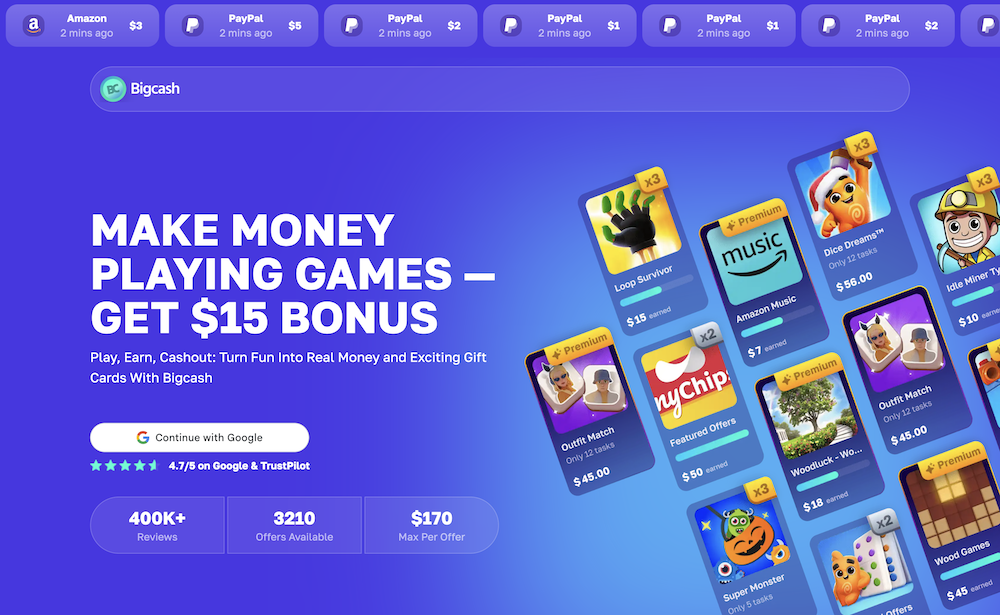
You are already on your phone. Bigcash pays you to play mobile games, finish offers, and try new services. Every offer you complete pays coins, and 250 coins equals $1. Bigcash lists more than 3,000 offers, says most take 5 to 10 minutes, and its biggest ones pay up to $170. You can cash out to PayPal or gift cards from $1. Bigcash’s own guide says PayPal’s charges can shrink a $1 cash-out, and its terms let it raise the minimum on an account.
It will not replace a job. Treat it as pocket money for your downtime, and skip any offer that wants you to spend money to finish it.
- Over 3,000 live offers on the platform now
- Cash out anytime through PayPal or gift cards with no complicated steps
- Get $15 bonus just for signing up and getting started
Testerup
Get paid to test mobile games and apps
The biggest sign-up bonus here, with the highest bar to cash it out.
Testerup pays you to test mobile games and apps and to answer surveys. New members get a $10 sign-up bonus, and it lists 90+ games and surveys to choose from. Every offer shows its reward before you start, and Testerup says some goals pay over $170. Most pay far less, so pick the games you’d play anyway. The catch is the wait: tasks run 15 to 20 minutes each, and the $10 welcome bonus is only a head start. Its sign-up page says payout requests are approved within hours. Its FAQ says to allow up to 3 business days.
Our Testerup review walks through how the goals and payouts work.
Freecash
Games, apps, surveys and shopping offers
A $10 head start, and plain talk about what users really earn.
Freecash pays you for playing games, trying apps, taking surveys and shopping through its offers. Where it runs a sign-up bonus, that bonus is a $10 account credit, added once you verify your email and start your first offer. Your first withdrawal needs an ID check and a minimum of $5 to $20, depending on your region. After that, PayPal withdrawals start at $5, and Freecash takes 5% of each one. Its own pitch is honest about the size of it: not life-changing money, but real. It says most users earn from a few dollars up to around $50 in a typical month.
Our Freecash review covers the cash-out rules in detail.
Branded Surveys
Points for trying apps, games and surveys
A small bonus, a low $5 cash-out, and honest numbers.
Branded Surveys pays points for trying apps and games and for taking surveys. New members get 100 points, and 500 points equals $5, which is also the minimum you need to redeem. It lists 200+ offers, and every offer shows its reward before you start. Branded says members can expect to earn between $5 and $100 a month, depending on how much they do and what is available. It also says this does not replace a full-time income.
See our Branded Surveys review for how the points add up.
Want more options? Take a look at our list of the best app bonuses.
11. Sites that find sign-up bonuses for you
You don’t have to hunt for sign-up bonuses one company at a time. These four sites round them up, each in a different way. None of them pays you. They show you an offer, and the company behind it pays once you meet its terms.
SavingLoop
One free spin a day for a sign-up offer
Does the finding for you, one offer a day.
Sign-up bonuses are out there. Finding one worth your time is the slow part. SavingLoop does the finding for you.
You get one free spin a day that unlocks a sign-up offer worth up to $75. Before you decide, it shows you the reward, how long the offer takes, and how you get paid. Spinning is free, with no purchase and no card needed.
SavingLoop doesn’t pay you itself. You sign up on the company’s own site, meet that company’s requirements, and the company pays you. Bigger offers come up less often, and each one has its own terms, so read them before you claim.
If you want the detail, my SavingLoop review covers how the daily spin works and what you can realistically unlock.
ReferralWallet
Free packs that reveal sign-up bonuses
This one is actually fun.
ReferralWallet turns sign-up bonuses into packs you rip open, and every pack shows a real sign-up bonus from an app or brand you already know.
Tear one open, see what dropped, and tap claim. From there you sign up on that company’s own site and meet its terms. There’s no deposit and no card needed to start. Its packs list the bonuses and rewards the companies behind them are offering.
ReferralWallet is a rewards directory, not a bank. It never holds your money and it isn’t the one paying. Every bonus is set and paid by the company behind the offer, and amounts can change, so confirm the offer on the company’s page before you sign up.
ReferralCodes
Sign-up bonuses sorted by category
Best when you want to see the whole list at once.
Plenty of banks, investing apps, and rewards apps pay new customers a bonus for signing up. Most people never claim one because they never see the offer.
ReferralCodes lists sign-up bonuses in one place, sorted by category: banking, investing, quick cash, crypto, gig work, credit and budgeting. It also lists cash advance apps, which are advances you repay, not bonuses. It’s free to use, with no paywall. Each listing shows the requirement up front. You sign up on the company’s own site, and that company pays the bonus.
Read the requirement before you click. Some of the banking and investing bonuses need a deposit first, so they aren’t free to qualify for even though your money stays yours. Bonus amounts change, so confirm the figure on the company’s own page before you count on it.
MoneyAnswers
A free four-step plan and a 90-second quiz
Best if you want to be told what to do first.
MoneyAnswers gives you a free money plan in four steps. It starts you on one app, then adds three sign-up bonuses. If your situation is different, a 90-second quiz points you to a plan for this week.
There’s no account to create on MoneyAnswers and nothing to pay. It’s also straight about the ceiling. Its own answer is that this is side money, not a salary.
12. Cash back on things you already buy
Cash back is the one kind of app money that only shows up when you spend. That makes it free money on a purchase you were already making, and a bad deal on anything you bought just to earn it.
Rakuten
Cash back when you shop online
Best for shopping you were going to do anyway.
Rakuten pays back a percentage of what you spend when you start a purchase through its site, app or browser extension. Store cash back typically takes 3 to 14 weeks to confirm, in case you return the order. Rakuten then sends your confirmed cash back every three months, by PayPal or check, once you have at least $5.01. A balance of $5.00 or less rolls over to the next payment date.
More in our Rakuten review.
MoreBest rebate and cash back apps for groceries, gas and more
13. Surveys, screen time and games
These three pay in points for small things. Surveys pay in small pieces, and the honest ones say so. Expect to be screened out of some, and count your time before you count the points.
Survey Junkie
Surveys for points you cash out
A simple survey site with a low $5 cash-out.
Survey Junkie pays points for taking surveys, and you can cash out starting at $5, which is 500 points. You earn a few points even when you don’t qualify for a survey. It checks your identity before you redeem, and its payout options can vary by location. How much you earn depends on the time you put in. Survey Junkie doesn’t promise an amount.
Our Survey Junkie review has more on how it pays.
MoreBest survey sites that pay
The next two ask even less of you. One pays for data about how you use your devices, and the other pays in gift cards for games you’d play anyway.
Nielsen Pulse
Rewards for keeping an app installed
The least work on the list.
Nielsen Pulse is a research app from Nielsen, the company behind TV ratings. You install it, grant the permissions it asks for, and let it run in the background while Nielsen studies how people use their devices. You earn points for setting it up and for keeping it connected each day. Nielsen doesn’t publish what a point is worth. The app shows the point values and the minimum you need before you can redeem. Points expire 12 months after you earn them, and only the head of household’s account can redeem. If you don’t pass its eligibility survey, it puts you on a waitlist. The trade is your usage data for a small reward. If that doesn’t sit right with you, skip this one.
Mistplay
Gift cards for playing mobile games
Fun if you already play. Paid in gift cards, not cash.
Download games through Mistplay, play like you normally would, and you earn points the whole time. You redeem those points for gift cards and prepaid cards. Mistplay says its catalog has more than 350 games. One thing to know before you start. The rewards are gift cards, not cash in your bank account. If you want cash, pick one of the apps above.
See our Mistplay review for how the points work.
What Is Not Free Money
The harder a pitch leans on the word free, the closer you should look. Some things sold as free money are just borrowing. Others are scams.
| It looks like free money | Why it is not |
|---|---|
| A loan or payday loan | You pay it back with interest. The Consumer Financial Protection Bureau says a common payday charge is $15 for every $100 borrowed, which works out to almost 400% a year on a two-week loan |
| A cash advance app | It’s your own next paycheck, early. You repay it on payday, and many apps charge for instant delivery or a monthly plan. Our guide to the best cash advance apps shows what each one costs |
| A game or app that needs a deposit to play | Money you put in is money you can lose. If you can’t get the deposit back, it was never free |
| A free trial that takes your card number | The FTC’s warning is simple. If you do not cancel on time, you will probably be charged |
| A check for more than you are owed, with a request to send some back | The check is fake. The FTC says money showing in your account does not mean the check is good, and you owe the bank when it bounces |
| A grant offered by call, text, email or social media | A scam. The FTC says the government will not get in touch out of the blue about grants, and real grants need an application for a specific purpose |
| Someone who will recover your money or refund for a fee up front | The FTC says government agencies and legitimate organizations will never ask for money to help you get a refund |
The tell is always the same. Someone asks for your Social Security number or bank details to see if you “qualify.” Then they ask for an up-front fee, often by gift card, wire transfer, or cryptocurrency. Once you pay, the money is gone and the grant never shows up.
The same test works for everything on this page. You should never pay to search for unclaimed money, file a settlement claim, or join a rewards app. If someone wants a fee first, walk away. You can report a scam to the FTC at ReportFraud.ftc.gov.
Need money today, not in a few weeks? That’s a different problem, and our guide for when you need money now covers it.
Free Money FAQs
The fastest options are sign-up bonuses, and they are small. Testerup gives new members a $10 sign-up bonus. Freecash adds a $10 credit where it offers a sign-up bonus, and Bigcash lets you cash out from $1. You can also take the free daily spin at SavingLoop to unlock a sign-up offer. The top one is $75, and SavingLoop says larger bonuses appear less often. The company behind the offer pays once you meet its terms. An unclaimed property search takes a few minutes too, but the state pays on its own schedule.
Apps that pay you for games, offers and surveys are the usual answer. Bigcash, Testerup, Freecash and Branded Surveys pay cash, Rakuten pays cash back on shopping, and Mistplay pays in gift cards. Expect pocket money, not a paycheck. Our list of money-making apps has more.
Use an app that cashes out to PayPal, and check its minimum first. Bigcash pays out from $1. Branded Surveys and Survey Junkie start at $5. Freecash needs $5 to $20 for your first withdrawal. Testerup pays through PayPal. We cover more ways in our guide to free PayPal money.
Start with money that is already yours. Search your state’s unclaimed property program through unclaimed.org, and check the federal databases listed on USA.gov. Then use the USA.gov benefit finder to see which programs you may qualify for, such as help with food, energy bills, child care or college costs. You apply for these, and they are not loans. The government will not call or message you to offer a grant, so treat anyone who does as a scam.
Sometimes. Unclaimed property and class action settlements cost nothing to claim, and rewards apps are free to join. Bank bonuses are different. Most need direct deposit or a minimum deposit before they pay. Bonuses and rewards can also count as taxable income. If anything asks you for a fee up front, it is not free money. Our list of the best bank account bonuses shows what each one requires.
Yes, when you use your state’s official program. The state officials who run these programs say there is no fee to search for or claim your property that way. Companies called finders may offer to do it for a share of what they find. That is usually legal, and you never need one.
FileYourClaim lists the open ones and links each to the official administrator’s site, where filing is free. Read who qualifies before you file, and only claim the ones that fit you. Our list of top class action settlements is another place to look.
Often, yes. A bank bonus is taxable. Chase, for example, treats its checking bonus as interest and reports it to the IRS on Form 1099-INT. Rewards from apps can count as income too. Getting back money that was yours to begin with, like an old deposit a state was holding, is a different case from a bonus.
Where to Start
If you do one thing today, search your state’s unclaimed property site. It takes minutes, and it’s money that’s already yours.
Then check your tax credits and the benefit finder. After that, look at the open class action settlements.
If you get paid by direct deposit, the bank bonus is the biggest single amount on the list. And if you just want something on your phone tonight, start with one app, not five. Check its cash-out minimum first.

