



You can’t claim 1 or 0 on the federal W-4 anymore. The IRS took allowances off the form in 2020, and the 2026 Form W-4 has no line for them. Here is what the old numbers did. A 0 had more tax taken out of every check, so your refund was bigger. A 1 took a little less, so your paycheck was bigger. You can still get either result. You just use different lines.
One thing first. If one job is your only income and you take the standard deduction, filling in Step 1 and signing Step 5 already withholds what the tax tables say you will owe. That plain form does what “single, 2 allowances” used to do. So today’s version of claiming 0 is the plain form plus a dollar amount in Step 4(c). I’ll show the numbers below.
Same results, different lines. Pick the result you want and use the line that does it.
Going with the bigger paycheck? You can get it sooner, too. Current, a mobile banking app, pays you up to two days early when you set up direct deposit, and how early depends on when your employer sends the money. Filling this out for a new job? You’re handing HR your direct deposit details anyway, and new Current users get a $75 bonus with code WELCOME75 once $1,500 of paychecks lands within 35 days of opening the account.
Tell me what you are trying to do and I’ll point you to the line. Tap the one that sounds like you.
What claiming 0 or 1 used to do
Through 2019, line 5 of the W-4 asked for your “total number of allowances.” Each allowance told your employer to ignore a slice of your pay when it figured withholding. More allowances meant less tax out of each check. Zero meant the most.
The form’s own worksheet gave a single person with one job two allowances: one for yourself and one for having only one job. So for a single person with one job, 0 and 1 were never the accurate answer. They were a way to have extra tax taken out on purpose and get it back as a refund.
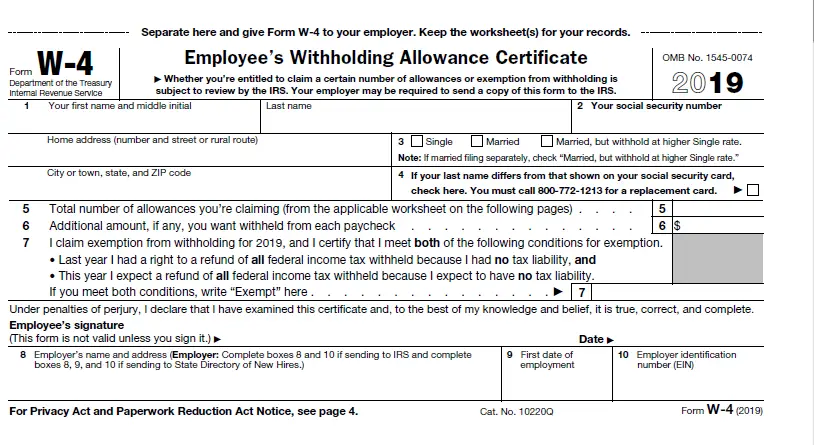
The IRS dropped allowances because their value was tied to the personal exemption, and the personal exemption is gone. It stays at zero for tax year 2026. Plenty of advice online still talks about allowances, which is why the question keeps coming up on Reddit and in forums like Intuit’s TurboTax community.
Still have a 2019 or older W-4 on file at a job you never left? It still counts. The IRS does not make you redo it, and your employer keeps withholding from it. For 2026, each allowance on that old form shields $4,300 of your yearly pay from withholding. The catch: the day you want to change anything, you have to use the current form. You can’t hand in a new one with a 0 or a 1 on it.
The old form and the 2026 form, side by side
Every job the old numbers did has its own line now.
| What you want | Old form (2019 and earlier) | 2026 Form W-4 |
|---|---|---|
| More tax withheld and a bigger refund | Claim 0, or add dollars on line 6 | Step 4(c): extra dollars each pay period |
| Withholding that fits one job | Single: 2 allowances. Married with one income: 3 | Check your filing status in Step 1(c) and sign Step 5. Leave Steps 2 through 4 blank |
| Less withheld because of kids | Extra allowances for each child | Step 3: $2,200 for each child under 17, $500 for each other dependent |
| Two jobs or a working spouse | The Two-Earners/Multiple Jobs Worksheet | Step 2: the Estimator, the worksheet or the checkbox |
| Tax withheld for income with no withholding | A worksheet that cut your allowances, or dollars on line 6 | Step 4(a), or extra dollars in Step 4(c) |
| Credit for deductions above the standard deduction | Extra allowances from a worksheet | Step 4(b), from the Deductions Worksheet |
| No federal income tax withheld | Write “Exempt” on line 7 | Check the “Exempt from withholding” box, new on the 2026 form |
What 0 and 1 are worth in 2026 dollars
Here is the translation the IRS gives payroll departments for old forms that are still on file (Publication 15-T for 2026). Each allowance is worth $4,300 of pay. A plain 2026 form for a single filer already leaves out $8,600, which is two allowances. So the old numbers line up like this.
| Old form entry | Pay withheld on | Extra a year at 12% | Extra a year at 22% |
|---|---|---|---|
| Single, 2 allowances | Same as a plain 2026 form | $0 | $0 |
| Single, 1 allowance | $4,300 more | $516 | $946 |
| Single, 0 allowances | $8,600 more | $1,032 | $1,892 |
Married works the same way with one difference. A plain 2026 form for married filing jointly leaves out $12,900, which matches the old “Married, 3 allowances.” The old Married 0 withheld on $12,900 more of your pay, which is $1,548 a year at 12%.
Which rate is yours? For a single filer with one job on the 2026 tables, taxable pay between $28,500 and $57,900 a year puts that whole extra slice at 12%. Between $66,500 and $113,200 it is all at 22%. Outside those ranges the rate is different or the slice straddles two rates, so use the Estimator instead of my shortcut.
How to copy the old 0 on today’s form (more withheld)
Take the yearly number and divide it by your paychecks. That goes in Step 4(c). Here is how I’d fill it out if I wanted the old 0 back: Single in Step 1(c), nothing in Steps 2, 3, 4(a) or 4(b), the amount from this table in Step 4(c), then sign Step 5.
| How you are paid | Old 1, at 12% | Old 0, at 12% | Old 1, at 22% | Old 0, at 22% |
|---|---|---|---|---|
| Every week (52) | $9.92 | $19.85 | $18.19 | $36.38 |
| Every two weeks (26) | $19.85 | $39.69 | $36.38 | $72.77 |
| Twice a month (24) | $21.50 | $43.00 | $39.42 | $78.83 |
| Once a month (12) | $43.00 | $86.00 | $78.83 | $157.67 |
Round it if you like. $40 a check on a two-week schedule is $1,040 a year, close enough to the old 0. And you are not stuck with the old menu. Step 4(c) takes any dollar amount, so decide how much extra you want held back over the year, divide by your pay periods and write that in.
Skip the shortcut some guides give, which is checking the box in Step 2(c). That box is built for households with two jobs. On a $52,000 salary it would withhold $2,965 more a year, almost three times what the old 0 took.
How to copy the old 1 or 2 (bigger paycheck)
If you were a 2, you are done after Step 1 and Step 5. If you were a 1, that is the plain form plus the “Old 1” amount from the table above in Step 4(c).
Want less taken out than the plain form takes? That only happens through real items: kids or other credits in Step 3, or deductions above the standard deduction in Step 4(b). There is no line for “take less because I said so,” and you sign the form under penalty of perjury.
One thing changes when you take the bigger paycheck. There’s no refund coming next spring, so the cushion is on you. If you bank with Current, its Savings Pods earn a 4.00% yearly bonus on up to $2,000 per pod, $6,000 in all, as long as a payroll deposit of $200 or more lands every 35 days. Anything above that earns nothing, so it’s a spot for the first few thousand, not all of your savings.
How to fill out the 2026 Form W-4, step by step
The form has five steps. Only Step 1 and Step 5 are required. The IRS reissues it every year, so the dollar amounts here are the ones printed on the 2026 form.
| Step | What you enter | What it does to your paycheck |
|---|---|---|
| Step 1 | Name, address, Social Security number and filing status | Sets the standard deduction and tax rates used: $16,100 single or married filing separately, $32,200 married filing jointly, $24,150 head of household |
| Step 2 | Only if you hold more than one job at a time, or you are married filing jointly and your spouse also works | Raises withholding. Without it, each job withholds as if it were your only one |
| Step 3 | $2,200 for each qualifying child under 17 and $500 for each other dependent, plus other credits you expect. For total income of $200,000 or less ($400,000 or less if married filing jointly) | Lowers withholding by that amount, spread over the year |
| Step 4(a) | Income that has no withholding, such as interest, dividends and retirement income. Not pay from a job or self-employment | Raises withholding |
| Step 4(b) | Deductions above the standard deduction, from the Deductions Worksheet on page 4 | Lowers withholding |
| Step 4(c) | Any extra dollars you want withheld each pay period | Raises withholding by exactly that amount |
| Exempt box | Checked only if you had no federal income tax liability in 2025 and expect none in 2026 | No federal income tax is withheld. It lasts one year. To stay exempt for 2027 you need a new form by February 16, 2027 |
| Step 5 | Your signature and the date | The form is not valid without it |
Two things are new on the 2026 form. The Deductions Worksheet now has lines for qualified tips (up to $25,000), qualified overtime (up to $12,500, or $25,000 if married filing jointly), car loan interest (up to $10,000) and a $6,000 deduction if you are 65 or older. The worksheet tells you to use those lines only if your total income is under $150,000 for tips and overtime ($300,000 married filing jointly), under $100,000 for car loan interest ($200,000) and under $75,000 for the 65 or older line ($150,000). And “Exempt” is now a box you check instead of a word you write in.
If your situation is more than one job and the standard deduction, let the IRS do the math. Its estimator takes about 25 minutes with a recent pay stub, does not ask for your name or Social Security number, and gives you a filled-in W-4 at the end.
Worked examples with the 2026 numbers
These are illustrations, not predictions of your tax bill or your refund. Each one uses the method payroll software uses (IRS Publication 15-T for 2026, Worksheet 1A and the annual tables), with wages only, the standard deduction and no credits unless I say so. Your own stub will differ if you have pre-tax deductions such as a 401(k) or health insurance. Amounts are rounded to the cent, so a line can be off by a penny, and payroll systems are allowed to round to the dollar.
Single, one job
A $52,000 salary, paid every two weeks, so $2,000 a check before anything comes out.
Now the tax itself. $52,000 minus the $16,100 standard deduction is $35,900 of taxable income. 10% of the first $12,400 is $1,240. 12% of the other $23,500 is $2,820. Total: $4,060. Same number. With one job and nothing else going on, the plain form aims at nothing owed and nothing refunded.
| What is on file | Withheld a year | Per paycheck | Against the $4,060 tax |
|---|---|---|---|
| 2026 form, Step 1 and Step 5 only | $4,060 | $156.15 | Even |
| Old form: single, 2 allowances | $4,060 | $156.15 | Even |
| Old form: single, 1 allowance | $4,576 | $176.00 | $516 over |
| Old form: single, 0 allowances | $5,092 | $195.85 | $1,032 over |
| 2026 form with $20 in Step 4(c) | $4,580 | $176.15 | $520 over |
| 2026 form with $40 in Step 4(c) | $5,100 | $196.15 | $1,040 over |
Whatever is withheld above the tax comes back when you file. Whatever is below it, you pay.
Two jobs or a working spouse
This is where people who claimed 0 still ended up owing. A married couple filing jointly earns $65,000 and $45,000. Both are paid every two weeks.
Why: each employer applies the couple’s full standard deduction and the lowest tax rates, as if the other paycheck did not exist. Step 2 is the fix, and the form gives you three ways to do it.
| Step 2 choice | What you enter | Withheld a year | Against the $8,840 tax |
|---|---|---|---|
| Step 2 skipped | Step 1 and Step 5 on both forms | $4,720 | $4,120 short |
| 2(b) worksheet | The table on page 5 gives $4,190. Divided by 26 paychecks, that is $161.15 in Step 4(c) on the form for the higher paying job | $8,910 | $70 over |
| 2(c) checkbox | Check the box on both forms. Job A then withholds $5,620 a year and Job B $3,220 | $8,840 | Even |
| 2(a) Estimator | The amount it gives you, in Step 4(c) | Depends on your entries | The most accurate option, according to the form |
The checkbox lands exactly here because the two paychecks are close in size. The form says it is accurate for jobs with similar pay and withholds too much when one job pays a lot more than the other. The worksheet table works in bands of $10,000 or more, so it gets close but not exact. If your pay is lopsided, you have more than three jobs, or more than one job pays over $120,000, use the Estimator.
One rule either way: fill in Step 3, Step 4(a) and Step 4(b) on only one form, the one for the higher paying job. Leave them blank on the other.
With children
A single parent who files as head of household earns $48,000, paid every two weeks, and has one child under 17.
That is the choice the old allowances made for parents. Enter the $2,200 in Step 3 and the credit shows up in your paychecks, about $84.62 each. Leave Step 3 blank and the same money is withheld all year and settled when you file. Two children under 17 is $4,400, or $169.23 a check on this schedule. Another dependent, such as a 17-year-old or a parent you support, is $500, or $19.23 a check.
Step 3 is for total income of $200,000 or less, or $400,000 or less if you are married filing jointly. The child has to be under 17 on December 31, be your dependent, generally live with you for more than half the year and have the required Social Security number. If you are not sure the credit is yours this year, leave it off until you are.
Side income
It depends on the kind. Interest, dividends and retirement income go in Step 4(a). Take the single filer from the first example and add $3,000 of bank interest.
Freelance and gig income is different. The form says not to put it in Step 4(a), because you owe self-employment tax on it as well as income tax. Using the 2026 worksheet in IRS Publication 505, self-employment tax alone on $6,000 of profit is $847.77 ($6,000 × 92.35% = $5,541, then × 15.3%). Income tax comes on top of that.
If you freelance or run your own business on the side, you have two ways to pay it. Run the Estimator and put its per-paycheck number in Step 4(c) at your day job, or make quarterly estimated payments with Form 1040-ES. With a large or uneven side income, this is where I’d stop guessing and use the Estimator or a tax professional. If you file on your own, make sure whichever of the best free tax software options you pick handles self-employment income.
Bigger refund or bigger paycheck?
A refund is not a bonus. It is your own pay, held by the IRS until you file, and the IRS points out that you earn no interest on it. Here is how I’d decide.
Withhold more if a lump sum is the only way you really save, if you owed last year and hated it, or if your income moves around and you want a cushion. Do it with a number you choose in Step 4(c), so you know what the cushion costs you each payday.
Withhold less if you are carrying credit card debt, have no emergency fund, or simply want your money as you earn it. In the first example the old 0 held back about $39.69 a check. That is $1,032 a year you could have had on payday, sitting in a high-yield savings account or paying down a balance.
If you do withhold extra, the IRS refund schedule shows when that money usually comes back next tax season. Sites like TurboTax let you plug in your income and see what you could owe or get back.
How to fix your withholding mid-year
A new W-4 only changes the paychecks you have not received yet. Your employer can’t take a catch-up payment for past pay periods. So a mid-year fix has to fit into the paydays that are left.
The IRS method is simple: figure how much you will be short for the year, then divide by the paydays remaining. Short $900 with 6 paydays left? $900 ÷ 6 = $150 in Step 4(c). The Estimator does the first half for you. Have your latest pay stub ready, because it asks what has been withheld so far.
It is not instant. Your employer has to put the new form into effect no later than the start of the first payroll period ending on or after the 30th day after you hand it in.
Late withholding still counts for the whole year. For the underpayment penalty, tax withheld from your pay is treated as paid in equal parts on each of the four payment due dates, no matter when it came out of your check. So a catch-up in the fall can cover a shortfall from the spring. A late estimated payment does not get that treatment.
Redo the form in January. A catch-up amount sized for 6 paychecks takes far too much over a full year. $150 a check for 26 checks is $3,900. The IRS says the same thing: if you change your withholding during the year, check it again for the new year.
When to send a new W-4
You can send one any time you want to change your withholding. In a few cases you have to. For 2026, the IRS says you must give your employer a new form within 10 days if one of these happens and you would otherwise not have enough withheld for the year.
- Your filing status goes from married filing jointly to single or head of household, or from head of household to single
- You or your spouse start another job
- You or your spouse expect a raise of more than $10,000 in regular pay at a second or third job, and the Step 2(c) box is not checked
- You can no longer claim a child tax credit you counted in Step 3
- Your other credits drop by more than $500, or your deductions drop by more than $2,300
- You claimed exempt and no longer expect to qualify
Outside of those, redo it when your life changes. The IRS says to check your withholding every January and after a life changing event such as a new job, a big change in income, a marriage, a divorce, a new child or a home purchase.
Two smaller rules. If you claimed exempt for 2026, the claim expires, and you need a new form by February 16, 2027 to keep it. And if you never hand in a W-4 at a new job, your employer has to withhold as if you were single with nothing else filled in.
What happens if you withhold too little
First, you owe the difference when you file. Second, if the gap is big enough, the IRS adds an underpayment penalty. You avoid the penalty if any one of these is true. The rules come from section 6654 of the tax code, and the IRS spells them out in the instructions for Form 2210 for tax year 2025, the latest version available.
- You owe less than $1,000 after subtracting what was withheld
- Your withholding and on-time estimated payments covered at least 90% of this year’s tax
- They covered at least 100% of last year’s tax. That rises to 110% if last year’s adjusted gross income was over $150,000, or over $75,000 if you are married filing separately
- You had no tax liability last year, it was a full 12-month year and you were a U.S. citizen or resident for all of it
The penalty works like interest on the amount you were short, for the time you were short. The worksheet for tax year 2025 used a rate of 7% a year in every period. The IRS will generally figure the penalty and send you a bill, so you usually do not have to fill out the form yourself. IRS Topic No. 306 has the short version.
There is also a separate $500 penalty for statements on a W-4 that lower your withholding when you have no reasonable basis for them. An honest mistake does not trigger it. Claiming children you do not have, or checking the exempt box when you know you will owe, can.
If you do end up owing, you do not have to pay for software to find out how much. There are free tax software options that handle a simple return.
Your state form may still ask for allowances
Everything above is the federal form. State income tax withholding runs on separate forms, and some of them still use the old language. California’s DE 4 asks for a number of allowances. So does New York’s IT-2104, and its 2026 version tells single filers with one job and no dependents to enter 0. Virginia’s VA-4 counts exemptions, starting with a line that says to write “1” if you wish to claim yourself.
So if your new-hire paperwork really does ask for a 0 or a 1, look at the top of the page. It is probably the state form. The dollar values are set by each state, so use the worksheet printed on that form, not the federal numbers in this article.
Bottom line
Stop looking for the 1 or the 0. Decide whether you want the money in your paycheck or in your refund, then use the line that does it: Step 4(c) for more withheld, Step 3 and Step 4(b) for less, Step 2 if there is a second paycheck in the house. Check it again every January. And when it is time to file, start with these ways to file your taxes online for free.
Claiming 1 or 0: FAQ
Neither, because the federal form no longer asks. Since 2020 the W-4 has had no allowances line. If you want what 0 used to do, which is more tax taken out and a bigger refund, fill in Step 1, sign Step 5 and put a dollar amount in Step 4(c). If you want what 1 or 2 used to do, which is a bigger paycheck, fill in Step 1 and Step 5 and add Step 3 if you have kids. Some state forms still ask for a number.
More withholding means more comes back at tax time, or less is owed. On the 2026 form you get that by adding an amount in Step 4(c). In the example on this page, a $52,000 salary paid every two weeks, about $40 a check matches what the old single 0 withheld, which is about $1,032 a year more than the plain form. A refund is your own money coming back with no interest, and its size also depends on your credits, deductions and other income.
Usually because of a second job, a working spouse or income with no withholding. Each job withholds as if it were your only one, so each applies the full standard deduction and the lowest tax rates. In the 2026 example on this page, a married couple earning $65,000 and $45,000 would come up $4,120 short with two plain forms. Step 2 fixes that. Side income needs Step 4(a), Step 4(c) or estimated tax payments.
On an old form that is still on file, single with 1 allowance withholds more than a plain 2026 form does, about $516 a year more for someone in the 12% bracket. So with one job and the standard deduction, a 1 alone usually does not leave you short. You owe when something is missing from the form: a second job, a working spouse, side income, or a credit you counted but cannot take.
If you are single with one job, the plain 2026 form already aims at owing nothing and getting nothing back. It withholds what the old single 2 did. Go for the old 0 only if you want a refund on purpose, and do it by adding an amount in Step 4(c). In 2026 terms, the old 0 withheld on $8,600 more of your pay than the plain form does, and the old 1 withheld on $4,300 more.
The federal form no longer takes a number for married filers either. If only one of you works, a plain form with married filing jointly checked in Step 1(c) matches what the old Married with 3 allowances did. If both of you work, two plain forms will usually not withhold enough, so use Step 2: check the box on both forms if your pay is similar, or use the worksheet or the Estimator. To copy the old Married 0, add an amount in Step 4(c). In 2026 terms it withheld on $12,900 more of your pay, which is $1,548 a year at 12%.
There is no 0 to claim. To copy it, check your filing status in Step 1(c), leave Steps 2, 3, 4(a) and 4(b) blank unless they apply to you, and enter extra withholding in Step 4(c). For a single filer in the 12% bracket, the old 0 works out to $1,032 a year. Divide by your pay periods: about $19.85 if you are paid every week, $39.69 every two weeks, $43 twice a month or $86 once a month.
Yes. The IRS does not make you file a new form just because the design changed. If your form is from 2019 or earlier and you never replaced it, your employer still withholds from it, and for 2026 each allowance on it shields $4,300 of pay from withholding. The moment you want to change anything, you have to use the current form.
No. Having extra tax withheld is allowed, and the form has a line for it in Step 4(c). The penalties run the other way. You can owe a $500 penalty for statements that lower your withholding with no reasonable basis, and you sign the form under penalty of perjury, so do not claim dependents, deductions or an exemption you do not qualify for.

